
How Stone Vaults Shape Choral Sound in Parish Churches
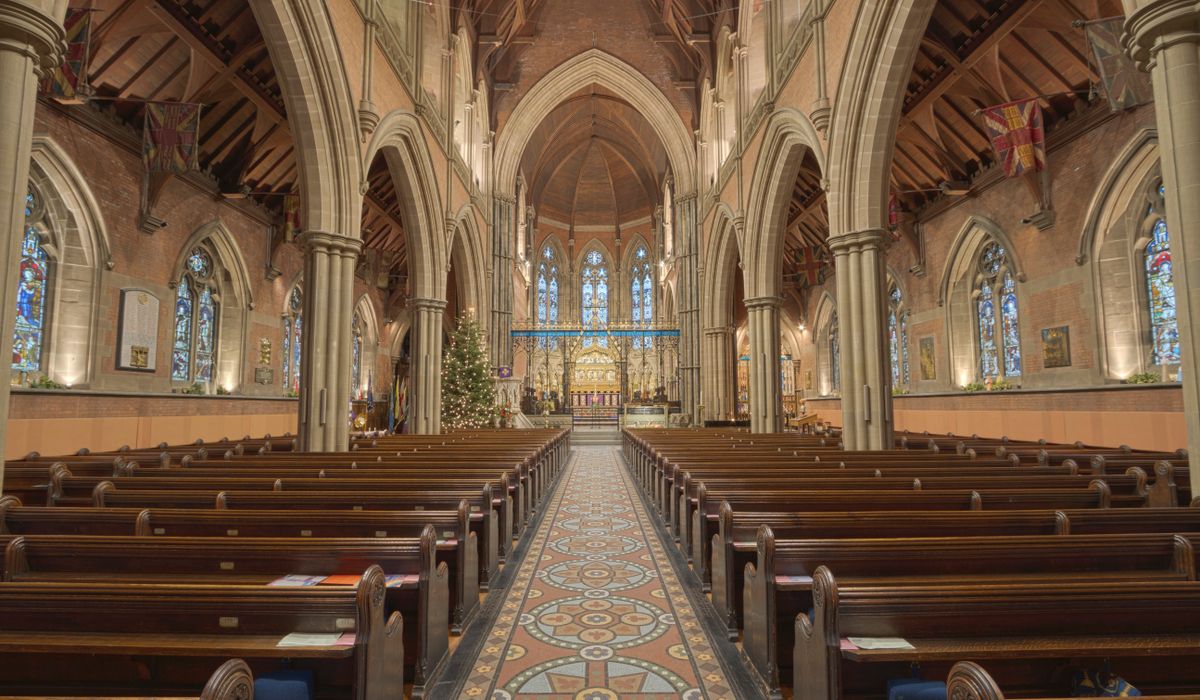
The Building as a Resonant Instrument
Stand in the chancel of an English parish church, sing a single sustained note, and listen. The sound does not simply leave your mouth and stop. It travels, strikes limestone, returns a fraction of a second later, strikes again, and again, each reflection fainter than the last. What you are hearing is the room's own voice, and for a choir it is more useful than any loudspeaker. A well-proportioned stone vault adds presence, bloom and blend without adding noise, because the reflections arriving within the first few tens of milliseconds are heard by the brain as part of the original sound rather than as a separate echo.
Most medieval naves and chancels settle at a reverberation time of roughly one and a half to two and a half seconds at mid frequencies when empty. That is generous but workable: long enough to make plainsong glow, short enough to keep a psalm chant intelligible.
How Pointed Arches and Ribbed Vaults Steer Sound
The pointed arch is not merely a stylistic signature. It carries the weight of the vault more steeply downwards than a semicircular arch does, which allowed medieval masons to raise thinner walls and pierce them with clerestory windows. Acoustically, that matters twice over. The vault itself becomes a broad, curved reflector overhead, gathering the upper partials of the choir and sending them back with a slight delay that thickens the tone. The windows, though glazed, remain hard enough to return a good deal of high-frequency energy into the room.
Ribs and carved bosses break up the great stone panels into smaller ones, each angled a little differently. Sound arriving at a quadripartite vault is therefore reflected back at slightly separated moments — a gentle scattering rather than a single hard slap. Choirs notice this as a halo around sustained notes, especially in the upper register. It flatters unison and simple harmony; it blurs rapid contrapuntal texts if the singers are not disciplined.
Piers, on the other hand, cast acoustic shadows. A choir tucked behind a nave arcade will sound distant and muddled to listeners in the aisles. Sing where the vault is continuous above you.
Limestone, Limewash and What Absorbs the Voice
Dense stones such as limestone and sandstone absorb very little mid-frequency sound, which is why historic churches sound so alive. But the soft things added over centuries quietly remove the choir's edge. Walk your church and note what sits between the singers and the stone:
- Carpet down the chancel steps and aisle runners, which swallow the lower mid-range.
- Pew cushions, stacked kneelers and hassocks left on the floor in quantity.
- Heavy curtains, banners and hanging textiles near the singing position.
- Upholstered modern chairs replacing timber benches.
- Large numbers of people: a full congregation of a hundred and fifty can noticeably shorten the decay and deaden the sound.
Warm air also absorbs high frequencies more than cold air does, so a heated, empty church often sounds slightly duller than a cold one. Rehearse in similar conditions to those you will sing in, or you will misjudge the balance.
Placing the Choir Inside the Vault
Keep the choir within a single vaulted bay. Spreading singers down the nave, or standing them on the chancel step under the flat nave ceiling, robs them of the vault that is doing the work. In churches with stalls on both sides, the traditional decani and cantoris arrangement is acoustically intelligent: singers hear one another directly across the gap, which tightens tuning and consonants, while the vault above blends the two sides into one sound for the congregation.
Ask one singer to step into the nave and report back. The director often hears something quite different from the listener, and a single benchmark — clarity of words at the back pew — is worth more than any amount of guesswork. If a solo line disappears, move the singer half a metre towards the centre of the vault rather than asking for more volume.
Choosing Music for the Decay You Actually Have
Estimate the reverberation time with a sharp clap, counting the seconds until the tail is gone. Above about three seconds, choose slower music: plainsong, Anglican chant, sustained anthems with long vowels and homophonic writing. Below about one and a half seconds, the room will support faster polyphony and crisper articulation, and you can afford more words per minute.
Whatever the space, place consonants together, as a section, slightly ahead of the beat. Vowels carry on the vault; consonants must be delivered almost simultaneously or the text smears. If sibilants hiss unpleasantly in a very live building, have the choir soften final "s" sounds rather than singing them out.
Small Adjustments That Make a Big Difference
Before anyone reaches for a microphone, try the building. Roll back a metre of carpet from the chancel. Lift the kneelers off the stone. Move the hanging banner. Rehearse once with the church full, or with the chairs arranged as they will be, and hear how much sound the people themselves absorb.
A little electronic reinforcement, used carefully, can help a spoken reading — but on a choir it tends to flatten the natural bloom and put one voice forward of the rest. Handled well, a stone vault remains the finest acoustic any parish can own. Learn where it reflects, learn where it swallows, and place your singers accordingly; the architecture will do the amplifying.

4 Comments